Big Data
Data Engineering Principles: Building Reliable Systems, Not Just Pipelines
Practical data engineering principles for designing reliable, scalable, observable and maintainable data platforms - from Kafka and CDC to data lakes and real-time analytics.

Modern data platforms are often introduced through technologies: Kafka for streaming, S3 for object storage, Iceberg for table management, Trino for distributed queries, ClickHouse for analytics, and SingleStore for real-time workloads.
These tools are valuable, but selecting tools is not the hardest part of data engineering. The difficult part is building a system that continues to produce correct, understandable, and useful data while schemas change, events arrive late, services fail, and data volumes grow.
A pipeline that works once is a demo. A pipeline that can be trusted, observed, replayed, and maintained is an engineering system.
The following principles guide how I think about modern data platforms.
1. Start With the Business Question
Every data system should begin with a decision, action, or user need—not with a technology.
Before designing a pipeline, ask:
- Who will use the data?
- What decision will it support?
- How fresh does it need to be?
- What level of accuracy is required?
- What happens if the data is late or unavailable?
These questions determine the architecture. A regulatory report may prioritize correctness, traceability, and reproducibility. An operational dashboard may require updates within seconds. A machine-learning feature pipeline may need consistent historical and online values.
Not every workload needs real-time processing. If data is consumed once a day, a well-designed batch process is often simpler, cheaper, and easier to operate. Real-time architecture should be driven by business latency requirements, not by fashion.
2. Treat Data as a Product
A dataset is not complete simply because it exists in a table. It becomes useful when people can discover it, understand it, trust it, and use it safely.
A reliable data product should have:
- A clear owner
- A documented purpose
- Defined consumers
- A stable schema or contract
- Data-quality expectations
- Freshness and availability targets
- Known security and retention rules
This approach changes the role of a data team. The goal is no longer just to move data from one place to another. The goal is to provide dependable products that analysts, applications, machine-learning systems, and other teams can use with confidence.
3. Design Contracts at System Boundaries
Many pipeline failures begin with an undocumented assumption between a producer and a consumer.
A producer renames a field. A timestamp changes format. A nullable column becomes mandatory. A numeric identifier starts arriving as text. The message is technically delivered, but the data product is broken.
Data contracts make these expectations explicit. A contract can define:
- Field names and data types
- Required and optional attributes
- Business meanings
- Allowed values
- Compatibility rules
- Ownership and change procedures
- Quality and freshness expectations
Schema registries can help in event-driven platforms, but technology alone is not enough. Teams also need a clear process for versioning, backward compatibility, validation, and deprecation.
The best place to prevent bad data is at the boundary where it enters the platform.
4. Make Pipelines Idempotent and Replayable
Failures are normal in distributed systems. Networks time out, consumers restart, jobs are retried, and messages may be processed more than once.
For that reason, a pipeline should be designed so that rerunning the same input does not create incorrect results. This is the principle of idempotency.
Common techniques include:
- Using stable event or business keys
- Deduplicating records
- Applying deterministic transformations
- Using merge or upsert operations where appropriate
- Tracking source offsets and checkpoints
- Separating ingestion time from event time
Replayability is equally important. If transformation logic changes or a downstream table becomes corrupted, the team should be able to rebuild the result from a durable source.
Kafka retention may provide a limited replay window. Object storage can preserve longer-term raw history. Change Data Capture can reconstruct changes from operational systems. Whatever the implementation, replay should be an architectural capability—not an emergency improvisation.
5. Preserve Raw Data, but Do Not Serve It Directly
Raw data is valuable because it preserves the closest available representation of the source. It supports audits, debugging, historical reconstruction, and future use cases that were not known when the data first arrived.
However, raw data is rarely suitable for direct consumption.
A practical platform often separates data into logical layers:
- Raw: Immutable or minimally transformed source data
- Validated: Parsed, typed, deduplicated, and checked data
- Curated: Business entities, historical models, aggregates, and reusable datasets
- Serving: Structures optimized for dashboards, APIs, search, or machine learning
These layers do not have to become a complex maze of duplicated tables. Their purpose is to separate responsibilities and make the progression from source data to business meaning visible.
In a data lake, raw events might be stored in object storage while curated datasets use Parquet files managed through Apache Iceberg. Trino can provide federated SQL access, while ClickHouse or SingleStore can serve workloads that need lower-latency analytical queries.
6. Model Time Explicitly
Time is one of the most underestimated sources of complexity in data engineering.
A single record may contain several different times:
- Event time: When the business event occurred
- Source commit time: When the source system recorded it
- Ingestion time: When the data platform received it
- Processing time: When a transformation handled it
- Effective time: When a business state became valid
These values are not interchangeable.
Streaming systems must expect out-of-order and late-arriving events. Historical models must define how corrections are applied. Slowly Changing Dimension tables must clearly represent when a version became effective and when it stopped being valid.
If time semantics are not defined early, teams eventually discover that they cannot accurately answer basic questions such as: What did we know at that moment? What was the valid state on that date? When did the platform receive the change?
7. Separate Storage, Processing, and Serving Concerns
One system rarely provides the ideal characteristics for every workload.
Object storage is durable and cost-effective for large historical datasets. Iceberg adds table-level capabilities such as schema evolution, partition evolution, snapshots, and transactional changes. Trino provides distributed access across data sources. ClickHouse is optimized for high-performance analytical queries. SingleStore supports low-latency analytics and transactional patterns. Kafka provides durable event transport and decouples producers from consumers.
The principle is not that every architecture needs all of these technologies. It is that each component should have a clear responsibility.
Avoid turning the event bus into a permanent database, the data lake into an operational API, or the serving database into the only copy of history. Clear boundaries make systems easier to scale, replace, and recover.
8. Optimize for Correctness Before Performance
A fast wrong answer is still wrong.
Before tuning partition sizes, indexes, compression, concurrency, or query execution, establish the expected result and test it. This is especially important for financial calculations, historical dimensions, incremental aggregations, and CDC pipelines.
Useful validation patterns include:
- Source-to-target row-count reconciliation
- Control totals for important numeric fields
- Uniqueness and null checks
- Referential-integrity checks
- Freshness validation
- Distribution and anomaly checks
- Comparison between full and incremental calculations
Performance matters, but optimization should preserve correctness. Once correctness is measurable, performance tuning becomes safer and more systematic.
9. Build Observability Into the Platform
Infrastructure monitoring tells us whether a server is running. Data observability tells us whether the data is usable.
A healthy pipeline can still produce stale, incomplete, duplicated, or logically invalid data. A mature platform therefore monitors at least four dimensions:
- Infrastructure: CPU, memory, disk, network, and service availability
- Pipeline: Throughput, lag, retries, failures, and processing duration
- Data: Freshness, completeness, uniqueness, validity, and volume
- Usage: Consumers, query patterns, dependencies, and service-level objectives
Every alert should provide enough context to begin diagnosis: the affected dataset, expected and actual values, the latest successful run, ownership, and downstream impact.
Observability is not a dashboard added at the end. It is part of the design of every data product.
10. Assume That Every Component Will Fail
Reliable architecture begins with a realistic assumption: every component will eventually fail.
The important questions are:
- Can the system retry safely?
- Can processing resume from a checkpoint?
- Can failed records be isolated?
- Can the output be rebuilt?
- Can operators identify the cause quickly?
- Is there a documented recovery procedure?
Dead-letter handling can prevent a single malformed event from stopping an entire stream, but failed records must not disappear into an ignored queue. Retries need limits and backoff. Checkpoints need to be consistent with writes. Recovery procedures need to be tested before an incident.
The objective is not to eliminate failure. It is to make failure contained, visible, and recoverable.
11. Keep the Architecture as Simple as the Requirements Allow
Complexity has a continuing cost. Every additional service introduces deployment work, monitoring, security configuration, operational knowledge, and another possible failure mode.
Use a new technology when it solves a clear problem better than the existing platform—not because it is popular.
A useful architecture decision should explain:
- The requirement being addressed
- The alternatives considered
- The operational cost introduced
- The expected benefit
- The conditions under which the decision should be revisited
Simple does not mean small or unsophisticated. It means that every component earns its place.
12. Design for Evolution
Data platforms are never finished. Sources change, volumes grow, business definitions evolve, and new consumers appear.
Systems should support evolution through:
- Backward-compatible schema changes
- Versioned transformations
- Automated tests and deployments
- Metadata and lineage
- Replaceable components with clear interfaces
- Migration plans for major model changes
- Data retention and lifecycle policies
Open formats such as Parquet and table formats such as Iceberg can reduce dependence on a single query engine. Data contracts can reduce uncontrolled producer changes. Modular pipelines can allow processing or serving technologies to evolve without rebuilding the entire platform.
Architecture should not predict every future requirement. It should make future change manageable.
13. Security and Governance Must Be Defaults
Security cannot be added after sensitive data has already spread across topics, buckets, tables, logs, and development environments.
Data platforms should apply:
- Least-privilege access
- Encryption in transit and at rest
- Classification of sensitive data
- Masking or tokenization where needed
- Audit logging
- Clear retention and deletion rules
- Separate production and development access
Governance should help people find and use data safely. If governance exists only as documentation that engineers bypass, it is not working. Good governance is embedded in platform workflows and automated wherever possible.
A Practical Reference Architecture
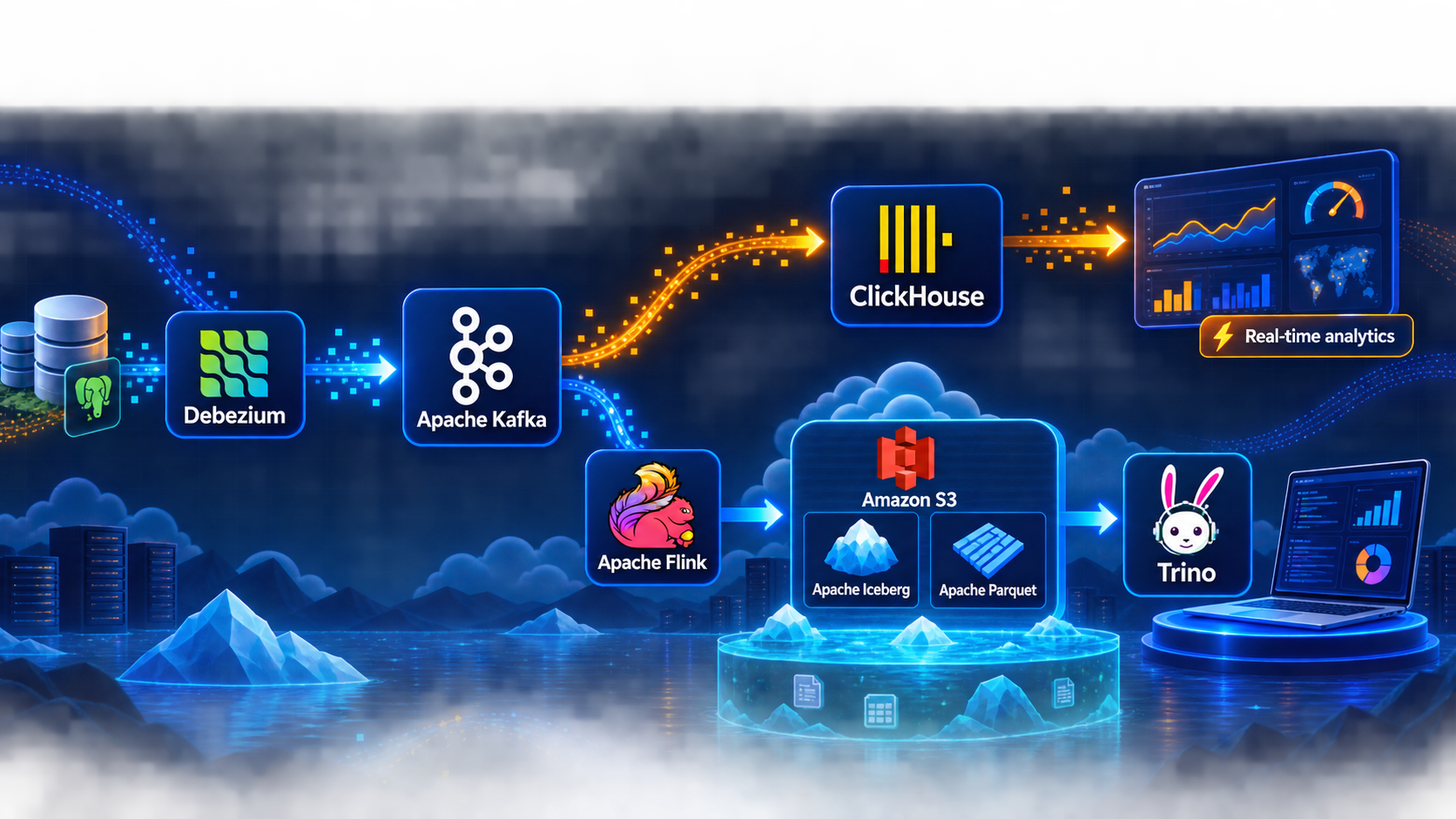
These principles can be implemented in many ways. One possible modern architecture is:
- Operational systems publish events or expose changes through CDC.
- Kafka decouples producers from downstream consumers.
- Raw events are retained in object storage for replay and auditability.
- Parquet provides an efficient columnar storage format.
- Iceberg manages reliable analytical tables and historical snapshots.
- Stream and batch transformations produce validated and curated data products.
- Trino provides SQL access across lakehouse and federated sources.
- ClickHouse or SingleStore serves use cases that require low-latency analytics.
- A catalog, lineage, quality checks, and monitoring provide governance and observability across the platform.
This is a reference, not a universal blueprint. The right design depends on latency, scale, query patterns, consistency requirements, operational capacity, and cost.
Final Thoughts
The strongest data platforms are not defined by the number of tools they use. They are defined by the trust they create.
Users should know what a dataset means, how fresh it is, who owns it, and whether it is safe to use. Engineers should know how a pipeline behaves under failure, how to replay it, and how to evolve it without breaking consumers.
Good data engineering turns unreliable events into dependable information. It balances speed with correctness, flexibility with governance, and modern technology with operational simplicity.
Tools will continue to change. These principles will remain.
İlgili Yazılar

Kurumsal S3 Dünyasında MinIO AIStor ve FlashBlade
MinIO AIStor ve Pure Storage FlashBlade çözümlerini performans, ölçeklenebilirlik, operasyon, güvenlik ve maliyet açısından karşılaştırıyoruz.
Building a Real-Time Lakehouse with Kafka, ClickHouse, Trino and Iceberg
Learn how Kafka, ClickHouse, Trino, S3, Parquet and Apache Iceberg work together to support real-time analytics, historical data and SCD tables.

SingleStore 9 vs. Previous Versions: A Practical Guide to the Real-Time, Hybrid Database
SingleStore 9 continues the evolution from a fast HTAP database into a broader real-time data platform for operational applications, analytics, search, and AI.