Science & Technology
How Do You Communicate With Someone When You Share No Language?
What Project Hail Mary made me think about: how two intelligent beings could build a language completely from scratch.
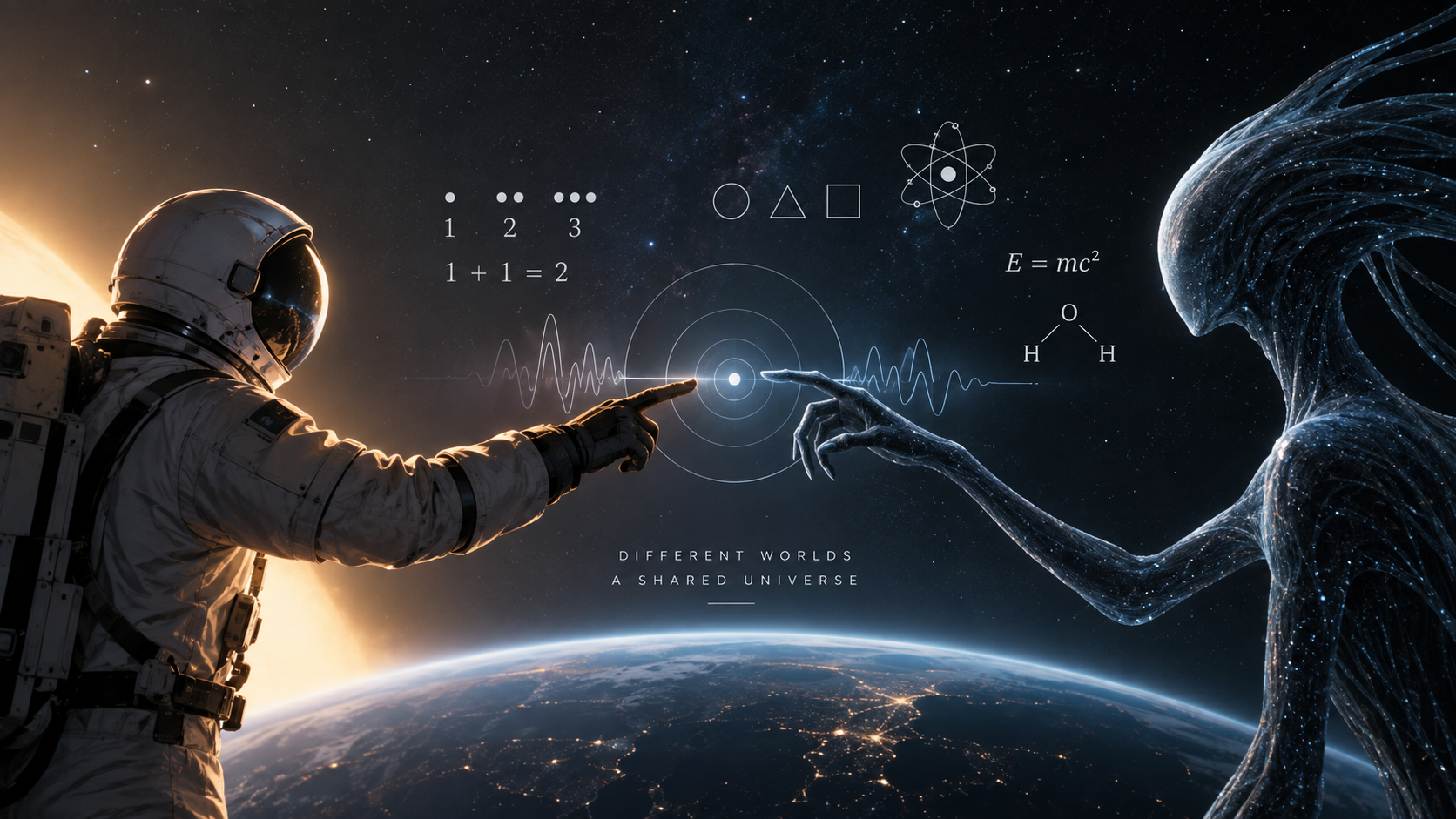
I recently watched Project Hail Mary, and one idea stayed with me much longer than the story itself:
How would you communicate with an intelligent being when neither side knows anything about the other’s language?
No English. No alphabet. No dictionary. No Google Translate. Possibly not even the same senses.
At first, this sounds almost impossible. But there is one thing both sides would still share: reality.
And that may be enough to build a language.
Start With Reality, Not Words
Imagine meeting an intelligent alien for the first time. You point at an object. You make a sound. You repeat it several times.
For example, you show a metal object and say: “metal.” The other being might respond with its own sound. You now have the beginning of a dictionary.
You do not know whether the sound means “metal,” “object,” “this,” or even “I acknowledge you.” That is why repetition and experimentation become important.
Show another metal object. Use the same word. Then show something that is not metal. Use a different word. Gradually, patterns begin to emerge.
This is essentially how language could be reverse-engineered.
Mathematics May Be the First Universal Language
Before words like “friend,” “danger,” or “help,” there is something much easier to establish: numbers.
Show one object. Then two. Then three. Eventually you can create patterns such as:
1
1 + 1 = 2
2 + 2 = 4

2, 3, 5, 7, 11, 13
Prime numbers could be especially useful. A naturally occurring intelligence capable of mathematics should recognize that this sequence is intentional.
At that point, an important milestone has been reached. Both sides understand: there is intelligence on the other side.
Mathematics does not require English, Turkish, Chinese, or an alien alphabet. It relies on patterns that emerge from the structure of the universe itself.
Physics Gives Us Another Shared Vocabulary
Mathematics can establish structure. Physics can establish meaning.
Both civilizations exist in the same universe. Hydrogen should behave like hydrogen. Light should have measurable frequencies. Gravity should follow consistent patterns. Atoms, electromagnetic radiation, orbital mechanics, and fundamental constants could therefore become reference points.
Instead of saying “This is hydrogen,” you could communicate:
atomic number = 1
proton count = 1
electron count = 1
Over time, both sides could create symbols representing physical concepts. This is one reason scientists often imagine mathematics and physics playing a major role in communication with extraterrestrial intelligence.
Objects Before Abstract Ideas
The easiest concepts to communicate are things that can be demonstrated: object, move, stop, take, give, hot, cold, large, small, near, and far.
You can physically demonstrate these concepts. Pick up an object. Make a sound. Repeat the action. Put it down. Make another sound. Eventually the other side may associate the sound with the action.
Once nouns and verbs exist, simple sentences become possible:
- Human takes object.
- Alien takes object.
- Human gives object to alien.
Now language has moved beyond labels. It has grammar.
The Most Important Words May Be Yes and No
A communication system cannot evolve efficiently without feedback. Both sides need some way of expressing “correct” and “incorrect,” or perhaps “yes” and “no.”
Once feedback exists, communication becomes an iterative learning system. One side proposes a meaning. The other confirms or rejects it.
Input → Prediction → Feedback → Correction → RepeatOver thousands of interactions, a shared vocabulary could become increasingly sophisticated.
Grammar Would Emerge From Patterns
Suppose the two beings already understand three concepts: human, object, and take.
You could demonstrate “Human takes object,” then “Alien takes object,” then “Human gives object.” By changing only one part of the interaction at a time, the other intelligence could infer which symbol represents the subject, object, and action.
This is similar to how linguists attempt to understand unknown languages. The meaning does not come from one sentence. It emerges from repeated patterns.
Abstract Concepts Are Much Harder
Physical objects are easy compared with concepts such as yesterday, tomorrow, friendship, trust, danger, death, hope, or promise.
You cannot simply point at “tomorrow.” Instead, abstract concepts must be constructed from things already understood.
Once both sides understand time, movement, planet rotation, before, and after, concepts such as yesterday and tomorrow can slowly emerge.
Language becomes a ladder. Every new concept depends on concepts established before it.
What If the Alien Cannot See?
There is another assumption we often make: that aliens would perceive the universe the same way humans do.
But what if they do not primarily use vision? They might communicate through sound, vibration, electromagnetic signals, chemical signals, temperature, pressure, or sensory systems we do not even possess.
In that case, the first challenge would not be language. It would be finding a communication channel.
Can the other being detect light? Sound? Radio waves? Physical vibration? Once a reliable channel is discovered, information can begin to flow.
Intent May Be Harder Than Vocabulary
There is another problem that might be even harder than learning words: intent.
Imagine receiving a signal from another intelligence. Is it a question? A warning? A greeting? A command? A threat? Are they expecting an answer?
Humans rely heavily on context, facial expressions, tone of voice, cultural conventions, and shared assumptions. An alien civilization would share none of those things.
So first contact would require learning not only vocabulary and grammar, but also something called pragmatics: the meaning behind communication.
Understanding what someone means can be much harder than understanding what they said.
Communication as a Shared Model
Eventually, both sides would not simply be translating individual words. They would be constructing models of each other’s language.
The human learns: “When they produce this sound after this event, it probably means X.” The alien does the same. Every successful interaction improves both models.
In modern terms, each side is effectively training a language model of the other.
The training data is conversation. The loss function is misunderstanding. The reward is successful communication.
Could AI Help With First Contact?
This becomes especially interesting today because artificial intelligence could dramatically accelerate the process.
Imagine continuously recording every sound, signal, movement, and response produced by another intelligence. An AI system could search for repeated patterns, statistical relationships, symbol boundaries, possible grammar structures, cause-and-effect relationships, and correlations between signals and physical events.
Instead of a human manually building a dictionary, machine learning systems could analyze millions of interactions.
The first alien-language translator may not be written by a linguist. It may be trained.
A Shared Universe Is the Starting Point
The idea that interests me most is that communication does not actually require a shared language. It requires something more fundamental: shared reference points.
Two intelligent beings might come from completely different civilizations. They might have different biology, different senses, different cultures, and different ways of thinking.
But if they can both observe the same universe, they already have something in common.
Numbers. Patterns. Matter. Energy. Time. Cause and effect.
From those simple building blocks, a language could slowly emerge. And eventually something far more important than language could emerge as well: understanding.
We may not share words with another intelligence, but we would still share the universe.
Related topics
You may also like
Science & Technology
Could AI Discover a Language Humans Cannot Understand?
Coming soon
Science & Technology
Why Mathematics Could Be Our First Message to Another Civilization
Coming soon
Science & Technology
What AI Teaches Us About Human Language
Coming soon